Saturday, November 21, 2009

Duel


It is amazing how much suspense you can build with almost no dialogue or sets, just a car and a very menacing truck. This is the film that turned Steven Speilberg from a tv director into a wanted filmmaker. Dennis Weaver stars as a mild-mannered traveling salesman. Driving along a small, California two-lane highway he decides to pass a large truck. No big deal. Happens a million times a day, right? This time the trucker does not appreciate the action. The trucker decides to chase down Weaver. The ultimate in road rage!

Spielberg's storytelling mastery shows. In a stroke of genius we never see the truck driver. It is just a beat-up truck chasing down poor Dennis Weaver. Spielberg later uses this same technique, to great effect, with the shark in Jaws. Of course, with Jaws, the shark didn't work correctly, but why quibble? In Duel Spielberg tells the story with a minimum of effects, dialogue or explanation. Just a rogue truck chasing down our unsuspecting lead. Suspense builds until a satisfying final scene.

Duel was written by Richard Matheson. He is now best known as the author of 'I Am Legend'. He also wrote one of the scariest things I remember from my youth. 'The Trilogy of Terror'. Pick that one up too if you can find it!

Simple, straightforward and powerfully suspenseful. I find Duel to be quite satisfying as well!

Filmed for TV in 1971, directed by Steven Spielberg, written by Richard Matheson, starring Dennis Weaver, Eddie Firestone, and a very menacing truck.

Friday, November 20, 2009

Wages of Fear/Sorcerer


This is a special day. Everyone gets two great movies for the price of one! Wages of Fear and Sorcerer. They are both the story of 4 men, on the run from their past, trying to escape their current desperation. They each decide to take a high-paying, life-threatening job driving nitroglycerin across an unnamed South American country. An oil company is paying huge bonuses to anyone who can get the nitro through to put out an oil well fire. Of course, nitroglycerin is very dangerous and will explode when bumped, jostled or warmed. Who will survive the trip and what perils will they face along the way?

Both of these movies are intense! The pressure builds as our drivers face numerous obstacles on the road to fortune and personal salvation. Jungles, mountains, rivers, guerrillas, each other and their own demons must be vanquished if they are to survive.

Wages of Fear was directed by Henri-Georges Clouzot. Filmed in 3 languages so the best prints are subtitled. Stay away from the dubbed version. Clouzot's film is raw, gritty and superb. Yves Montand is fabulous as Mario. We don't know how he got into his personal hell, but he wants out. Clouzot allows the suspense to build until you almost want to scream. At one point I even covered my eyes and looked between my fingers. It's safer that way.

Sorcerer is William Friedkin's remake. He was fresh off The French Connection and The Exorcist so the studios gave him anything he wanted. It shows. Roy Scheider does a nice job reprising the Yves Montand role. Friedkin goes a little overboard in the first half, but the remainder of the film is just as intense as Wages of Fear. The shot of the trucks driving over rope bridges in a pouring rain is worth the price of admission. The Tangerine Dream soundtrack is quite wild.

Intensity builds to a big finish in both films. Similar in their story, each is a unique experience. Wages of Fear is more respected by critics, but both films deserve a viewing.

Wages of Fear was filmed in 1952, directed by Henri-Georges Clouzot, written by Clouzot and Jerome Geronimi, starring Yves Montand, Charles Vanel, Folco Lulli and Peter Van Eyck.

Sorcerer was filmed in 1977, directed by William Friedkin, written by Walon Green, starring Roy Scheider, Bruno Cremer, Francisco Rabal and Amidou. Both are based on the novel by Georges Arnaud.

Thursday, November 19, 2009

Quadrophenia


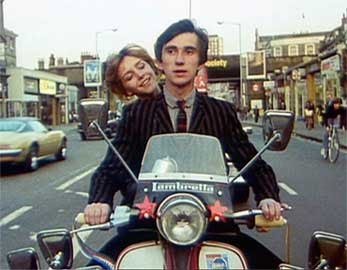
Music by The Who. Acting debut of Sting. Mods vs. Rockers. Music by The Who. Scooters everywhere. The end of innocence. This is a coming of age tale set against the backdrop of early 60's mods/rockers riots in Brighton. Did I mention the music by The Who?

In case you hadn't noticed, I love The Who. The soundtrack and performance footage alone make this film worth seeing. But add to the tunes a wonderful story of a young man trying to find his place in the world. Jobs, girls, drugs, music, scooters. All the choices that, in our own way, we all faced during our turbulent adolescent years.

Director Franc Roddam does a terrific job with this "angry young man" story that is inspired by the Pete Townsend rock opera of the same name. Phil Daniels as Jimmy carries the angst in every scene. I root for him to succeed, find love, mature and enjoy life. For him, as for most young adults, it is a difficult journey. But well worth sharing. For me it was the Punks vs. Rockers in the 70's, but the film's transcendent storyline really strikes home.

Quadrophenia is also the acting debut of Sting. The lead singer of The Police does a terrific job as Ace, the idol of all the mods. He lives and works in Brighton and is a central figure in the second half. I remain impressed with Sting's screen presence. All the actors do fine work. They give this film a very authentic mood.

This is a hidden treasure. The story, the scenery, the scooters and the soundtrack make Quadrophenia a film worth treasuring.

Filmed in 1979, directed by Franc Roddam, written by Roddam, Dave Humphries and Martin Stellman, starring Phil Daniels, Leslie Ash, Mark Wingett and Sting.

Wednesday, November 18, 2009

The Hustler


I invited a few friends over to watch this film. None had ever seen it. They were all quite impressed by this hidden gem. Nominated for 4 acting Oscars, Best Picture, Best Director, Best Screenplay and more. The Hustler tells the story of Fast Eddie Felson, pool-hustler extraordinaire. He travels the small-time circuit looking for people to hustle in a game of pool. He is, of course, better than anyone he ever meets. He allows them to win, ups the stakes and takes them for everything they've got. Many of his opponents don't appreciate the treatment. Later he challenges Minnesota Fats to a big-money game. The action between Fast Eddie and Fats is intense and furious.

The atmosphere of pool halls can be felt by the viewer. I can smell the smoke, taste the beer, feel the desperation while I watch. The cinematographer Eugen Shuftan won an academy award. The Hustler also won for art/set direction. Both are well-deserved. However, it is the actors that carry the movie. Paul Newman is stunning. He is Fast Eddie Felson. Both he and fellow nominee Jackie Gleason did all their own pool shots for the film. Piper Laurie, as Fast Eddie's on-off love interest is amazing. I truly feel for her as I watch. George C. Scott, who refused his nomination for best supporting actor, is fantastic as Newman's big backer.

The Hustler is also credited with saving pool in America. The game was being outlawed and run out of many American cities and towns. Pool was thought to be decadent. According to R.A. Dyer's book 'Hustler Days' pool was on its death bed. Then this movie came out and brought pool back into the mainstream. Millions started playing, pool halls opened across the land and the game was saved. Not bad for a movie.

Filmed in 1961, directed by Robert Rossen, written by Rossen and Sydney Carroll, starring Paul Newman, Jackie Gleason, Piper Laurie, Michael Constantine and George C. Scott.

Tuesday, November 17, 2009

His Girl Friday


Hilarious. The dialogue is as witty as has ever been filmed. The pace is breakneck speed. I find myself trying to stop laughing at one line because I have another laugh or two lined up. Cary Grant and Rosalind Russell are fantastic. They have terrific timing, great chemistry and some of the best dialogue imaginable. You have to pay attention to the dialogue. Often there are two conversations going on simultaneously. You can follow one or both, but do follow along. Don't miss anything.

Based on the play The Front Page by Ben Hecht and Charles MacArthur. Charles Lederer adapted the screenplay with wonderful results. Director Howard Hawks insisted the part of Hildy (Russell) be rewritten for a woman. This allows for a romance subplot underneath the newspaper main storyline. Cary Grant owns a newspaper and is divorced from Rosalind Russell. She returns to the paper to inform her ex that she is remarrying. He constructs a plot to regain her affections and to get her back as his ace reporter. Ralph Bellamy does a nice job as the kind, but slow, husband to be. Of course, he has no chance when put up against Cary Grant. But then who does?

His Girl Friday is a classic comedy done at light speed. Don't go for popcorn because you will miss out.

Filmed in 1940, directed by Howard Hawks, written by Charles Lederer, starring Cary Grant, Rosalind Russell and Ralph Bellamy.

Sunday, November 15, 2009

Paths of Glory


I consider this to be the best film that remains unseen by many. Voted to almost every "greatest" movies poll it is must viewing for anyone who enjoys movies! This film is about World War I, but Paths of Glory is the most anti-war movie ever released. Leonard Maltin says "shattering story of the insanity of war" and "stunningly acted and directed". The New York Times says "its message growing only more pertinent and potent with each passing year". I say it is one of the most powerful films that I have ever seen. Just writing this blog refreshes the emotions I experienced viewing Paths of Glory. Anger, frustration, disgust, I want to yell at the participants about their actions. Any film that can do that should be seen by all.

Director Stanley Kubrick's best work. I love Dr. Strangelove. I have seen Spartacus about a dozen times. A Clockwork Orange still intrigues me. But Paths of Glory is his crowning glory. This film is superbly acted, written and directed. Kirk Douglas is powerful. Adolphe Menjou and George Macready are terrific as Douglas's commanding officers. The script, written by Kubrick, Calder Willingham and Jim Thompson is top-notch. Based on the novel by Humphrey Cobb which is based on the actual trial during World War I.

One important fact. The film is about French officers and soldiers during World War I. After this film was released it was banned in France!

Paths of Glory tells the tale of an ill-advised, almost suicidal, French attack upon a German position. Douglas, portraying the field commander, does not want to proceed. He is pressured into making the attack with disastrous results. 3 of his men are chosen to be tried for cowardice after the failed action. Douglas defends these men at their trial. I find that I run out of adjectives as I write this entry. Stunning, superb, powerful, emotional and must-see are just a few.

Filmed in 1957, directed by Stanley Kubrick, written by Kubrick, Willingham and Thompson, starring Kirk Douglas, Adolphe Menjou, George Macready and Ralph Meeker.

Saturday, November 14, 2009

Hearts of Darkness


Excellent documentary on the making of Francis Ford Coppola's epic Apocalypse Now. Unprecedented access into the making of a major motion picture with hours of footage provided by Coppola's wife Eleanor. Documentary also includes interviews, filmed a decade later, with Francis and Eleanor Coppola, Martin Sheen, Vittorio Storaro, Laurence Fishburne and others.

The filming and production of Apocalypse Now is as much an epic as the final film. A typhoon destroyed all the sets, Martin Sheen has a major heart attack in the middle of filming, Harvey Keitel is replaced as the lead, Marlon Brando refuses to cooperate, the Philippine Army yanks all the helicopters, and Coppola has to put up his own money to see the film finished. A 100 day schedule balloons into 238 days of intense filming.

Most intriguing is the parallel between the script and Coppola's experiences filming. His own self-doubt and the constant strain as writer/director push him into a kind of madness that is reflected in the main character Willard (Martin Sheen). It is only through force of will that the film is finished. And it is only through that same force that Willard can complete the mission onscreen. Coppola and Willard share an obsession that sees them through unbearable pressures.

One warning. The documentary is rated R primarily due to the footage of a native animal sacrifice scene. While the footage lasts less than a minute it is accurate and somewhat disturbing. You may wish to fast forward through the scene.

Filmed in 1976-77 with additional footage shot in the late 80's, directed and written by Fax Bahr and George Hickenlooper.