Showing posts with label Action. Show all posts

Wednesday, December 21, 2011

Decision Before Dawn


1952 nominee for Best Picture is relegated to the rarely seen pile of lost movies. I am a large cinema buff and just viewed this for the first time. No showings on Memorial Day, Veteran's Day nor any other typical platform for WW2 films. Perhaps that is because it is about Germans. Specifically Germans who are captured that agree to return to Germany, before the end of the war, and spy for the Allies. Espionage is a difficult subject to portray when you are spying on your own country of birth. For a spy film to be successful the traditional formula is for a patriotic vision in which a hometown boy risks life and limb for God and Country. But here the spies are spying upon their own homeland. Risky subject matter.

Decision Before Dawn handles the issue with aplomb. Because it is a true story, one in which the writers took little liberty to change the facts for "dramatic" reasons, this film held my attention throughout. Based on the book by George Howe who was an Army Intelligence Officer during the war. It is the first film, at least that I can think of, after WW2 that portrays ordinary Germans as people not as warmongering barbarians. People who are caught between a fanatical regime and a horrible war. I have thought about the situation that these "spies" faced. Returning home to report on your countrymen in an effort to end a bloody war. A most difficult situation for anyone.


Director Anatole Litvak does a fine job juggling the characters and emotions. Coming off of his Oscar nominated direction of 'The Snake Pit' he was given the opportunity to tell a different story in a very direct fashion. There are a few moments of patriotic fervor, but overall the tone is honest and direct. But the real focus of the movie is held by Oskar Werner. This Austrian-born actor plays the torn, but compelling spy 'Happy'. Much of the story inside Germany focuses upon his efforts to obtain important information. His handling of the emotions felt by a person faced with such choices is excellent. Richard Basehart and Gary Merrill, two well known character actors, play his American supervisors. Both are strong in their supporting roles. I also appreciated the work of Hans Christian Blech. He plays another German who volunteers to go back to Germany and spy, but his motives and actions are much clearer than Werner's.

This is a simple film that tells a complicated story. I appreciate the efforts of the Director, Screenwriter and cast to provide insight into a most difficult situation. One fun aside:look for Klaus Kinski in one of his first films. He plays the whining soldier.

Filmed in 1952, directed by Antole Litvak, written by Peter Vertiel from the book by George Howe, starring Oskar Werner, Richard Baseheart, Gary Merrill and Hans Christian Blech. Spoiler alert! One interesting note:actor Oskar Werner's character is captured the same day, December 8th, 1944, that real-life Oskar Werner defected from the Wehrmacht.

Friday, March 25, 2011

The Train


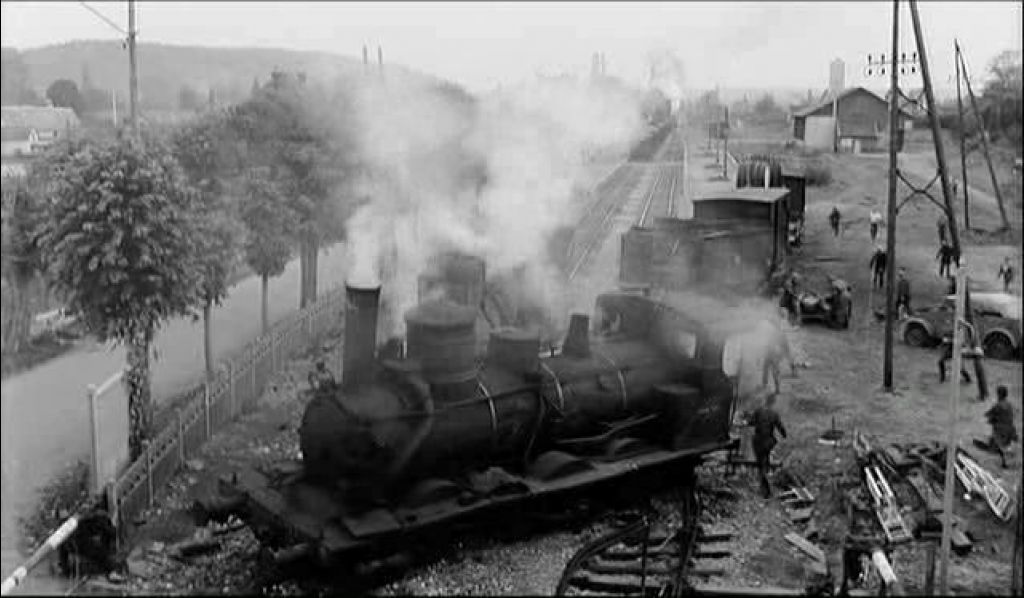
This is a most odd and excellent film. In many ways it defies expectations. It is a story of the French resistance fighting the Germans just as Paris is liberated by the Allies. But this movie is not a WW II epic. It stars Burt Lancaster. But he does not portray the typical leading man. The Train is directed by John Frankenheimer. But this film is nothing like his masterpiece 'The Manchurian Candidate' nor his hidden gem 'Seconds' (which was the subject of my first article). It is based upon a true story, but views like an action thriller. So instead of many cliches and typical/expected scenes, this film features a thriller atmosphere with unique characters and intriguing action.

The plot is simple. A German officer is stealing hundreds of rare paintings from Paris museums just as the Allies are to arrive in Paris during 1944. Picassos, Renoirs, Van Goghs, Gaugins, Cezannes and a dozen other artists for the ages. He loves the art, but convinces his superiors that the value of the paintings means they must be whisked away to Germany before the NAZIs leave France. Lancaster plays a railroad yard supervisor who is part of the French underground. The resistance wants him to save the paintings as a "national treasure". He could not care less about art and worries about who might be injured or killed in this dangerous missions just hours before they would all be liberated. But, of course, he eventually takes the mission and must stop the train from leaving France.


Although the plot is simple, Frankenheimer rarely is. The director weaves a fabulous action/caper thriller that features subterfuge, air raids, sabotage, hostages and a dozen other moments to keep us intrigued. I spent the entire time viewing this film with an anticipation of "what could be next?". I appreciate a movie that keeps me engrossed in the action. How could these few resistance fighters stave off the NAZIs and save the artistic heritage of a nation? I won't spoil it, but they use some very unique and interesting tricks, stunts and attacks to try to save the day. But is it possible? You will have to watch The Train to find out for sure!

No look at this film is complete without a mention of the fantastic performance by Paul Scofield. His work as the German officer hell-bent on keeping these masterpieces in his own, and by extension German, hands is powerful. You can feel his drive and desire throughout the film. The Train is almost a battle of wills between Scofield's German officer and Lancaster's French resistance fighter. And an action-packed battle it is. Also, the screenwriter's fine work was rewarded with an Oscar nomination.


Filmed in 1964, directed by John Frankenheimer, written by Franklin Coen & Frank Davis from the novel by Rose Valland, starring Burt Lancaster, Paul Scofield, Jeanne Moreau and Albert Remy. For more info on the Germans attempts to loot the art of France and the Allies efforts to recover it, check out Valland's fantastic book 'Rescuing Da Vinci'. It is most interesting.

Sunday, July 25, 2010

Leon - The Professional


This is a most unique film. It has elements that I found captivating and others that made me quite uncomfortable. But, overall, Leon-The Professional is well worth a look.

In 1994 French director Luc Besson had a break in his schedule. He was about to start 'The Fifth Element' starring Bruce Willis. However, Willis was delayed working on his current project. Besson did not want to lose the crew and decided to make a feature film about a character from an earlier work. This film focuses upon the Jean Reno character from Besson's 'La Femme Nikita'. In 'Nikita' Reno stars as Victor the Cleaner, a professional hit man. Here he becomes Leon-The Professional.

Leon is a slow individual who has come to America and become a professional thug. He has become a master at his craft by refusing to become involved with anyone or anything. Natalie Portman, in her debut, portrays Mathilda. Mathilda is 12 and lives in the apartment next door. Her father is involved in transporting drugs and her entire family is killed when her father tries to steal some drugs. Leon saves Mathilda and she vows revenge. Gary Oldman, at his creepiest best, plays Stansfield. He is the head of the drug gang. Mathilda convinces Leon to teach her to be a "cleaner" so that she can avenge her father and brother's deaths. He reluctantly agrees and they develop a camaraderie. I will leave the story of their success or failure for you to view unspoiled.


Reno, Portman and Oldman are all fantastic. Director Besson, who also wrote the script, gets great work from all three. Oldman's ability to petrify and disturb the viewer is put to full value. He is over-the-top and under-control at the same time. But the bond between Reno and Portman makes the film, somehow, touching. Leon comes to realize that his life has been entirely empty while Mathilda needs his guidance and protection. They become important to one and another. That special relationship propels Leon-The Professional from typical action/assassin flick into something much more. However, that relationship is also a little creepy. There is an underlying tone of sexuality. Remember, Mathilda is 12. In France that may be standard, but in the US it is uncomfortable. I found myself squirming, just a little, at a few moments of their interaction. As did American audiences. The film was edited, to remove much of this content, for American release. Pick-up either the international version or US version depending upon your preference.

But Besson has made one of his best films. He may be better known for 'The Fifth Element' and 'The Transporter', but this film and 'Le Dernier Combat' represent his finest achievements. For a film about drug deals gone bad, professional hitmen and the murder of a young girl's family, Leon-The Professional is somehow warm and sweet. I hope you enjoy.

Filmed in 1994, directed and written by Luc Besson, starring Jean Reno, Natalie Portman, Gary Oldman and Danny Aiello. For more info on 'Le Dernier Combat' you can read my earlier article here.

Saturday, April 10, 2010

Vanishing Point


The late 1960s and early 1970s saw the evolution of the car chase in cinema. Chase cinema evolved from films like 'Bullitt' (my post) and 'The French Connection', which used car chases to develop tension and continue the drama, to later films, like 'Gone in 60 Seconds' and 'Dirty Mary, Crazy Larry' (my post) in which the car chase was the drama and the story was just to get to the action. Some of the biggest directors of today got their start on just such films. Oscar winner Ron Howard started with 'Grand Theft Auto' while multi-Oscar winner Steven Spielberg first directed 'Duel' (my post). They may be making much more cerebral cinema today, but, as young directors, they loved a great car chase! I find that car chase films offer film makers the opportunity to discuss the classic individual vs. society storyline. The driver wants to be free to travel as they wish while the police want them give up their freedom and obey the rules. That is a plot, in one form or another, that goes back as long as stories have been told.

Vanishing Point is from the later group of car chase movies. The storyline is to get us interested in the characters, but the action of the automobiles is what keeps us watching. In this case, it is a 1970 supercharged Dodge Challenger. Barry Newman plays Kowalski, a former cop who has fallen upon hard times. Through a series of short flashbacks, we learn that he was a decorated war hero and police officer who was removed from law enforcement and tried to make a living racing cars. After a personal tragedy his driving career fails and he turns to delivering cars from one city to another. It is on such a trip, from Denver to San Francisco, that our story unfolds.


He meets many characters along the way. This movie being made in 1971, those characters include hippies, racist cops, drop-outs, motorheads, faith healers and a large assortment of the 60s crowd. Clevon Little, of 'Blazing Saddles' fame, stars as 'Super Soul'. He is the dj of a Nevada radio station who deeply empathizes with Kowalski. He is doing his best to assist our driver as he attempts to allude police on a four state chase. One advantage to having a radio dj in the film in the opportunity to include some great soul music. The soundtrack alone makes this a film worth enjoying.


I will not spoil it with details, but film aficionados have been debating the ending since the premiere. I find it to be a fantastic climax while others complain and offer alternate endings. Car chase films have but two possible endings. One, the driver, our hero, escapes the police and goes on to drive another day. Or two, the police, the symbol for the end to freedom in our lives, stop the car from proceeding and imprison the driver. I won't tell you which ending Vanishing Point has, but, after viewing, drop me a line and tell me what you think. stevethemovieguy@gmail.com. I look forward to your opinion.

This is one of the classic car chase films. Remember that this was made before computers took over movies. All the driving, crashing, jumping and more was done by real people in real cars. Oh how I long for the days of stunt people!

Filmed in 1971, directed by Richard Sarafian, written by Guillermo Cain, starring Barry Newman, Clevon Little, Dean Jagger and Gilda Texter as the nude motorcycle rider.

Sunday, March 14, 2010

The Anderson Tapes


I love caper films. If you have read my earlier blogs this comes as no surprise. I have previously reviewed 'The Taking of Pelham One Two Three', 'Thunderbolt and Lightfoot', 'Charlie Varrick' and others. Director Sidney Lumet turns master crime writer Lawrence Sander's novel into a fast-paced caper film extraordinaire. Sean Connery stars as 'Duke Anderson'. Just released after 10 years in prison, Anderson decides to rob an entire upscale apartment building. He brings in a crew of specialists that is headed by Martin Balsam and Christopher Walken. Balsam is an antiques expert that scouts the apartments for paintings, jewels and other valuables. Walken, in his film debut, is a pal of Connery's from prison who works with phone lines and other electronics. Anderson uses various contacts to plan and orchestrate this robbery deluxe.

Little does he know that almost every action he takes is being taped. Either the IRS, FBI, CIA or other government agency is following many of the people with whom he meets. These are the tapes referenced in the title. Even his long-lost girlfriend, played by the very attractive Dyan Cannon, is being watched. Since there are many parties to such a robbery it is complex and time-consuming. Can the crew pull off such a mighty feat of crime? Will one or more of the agencies taping Anderson realize what is going on and prevent the robbery?


Sander's novel and the screenplay by Frank Pierson provide many unique twists and turns. I can not think of another caper film that has the feel of The Anderson Tapes. Lumet's direction, as always, is first-rate. He moves the setting of the film back and forth from pre-to-post robbery throughout. This makes it both easier and more difficult to predict the outcome. I found it to be a master stroke of direction. But it is the always attention-grabbing Sean Connery that carries the film. He is likable enough to root for the criminals, but dark enough to be believable. Balsam is also good. His slightly over-the-top portrayal of the antiques dealer is quite endearing. And Walken shows some of the brilliance that we will see later in his long career.

Whether it is for the intelligent caper, the fine script and direction or the terrific cast, The Anderson Tapes should keep you entertained. There is also the Quincy Jones soundtrack. It is an intriguing combination of early disco with electronic music. Everyone either loves it or hates it. Personally, I think it's great.


Filmed in 1971, directed by Sidney Lumet, written by Frank Pierson, starring Sean Connery, Martin Balsam, Christopher Walken, Dyan Cannon and Alan King. For all the Saturday Night Live fans, look for original cast member Garrett Morris as one of the police officers.

Friday, March 5, 2010

Der Tunnel (The Tunnel)


Wow! I just finished watching this outstanding movie. I am going to have to eat my words about German cinema. This makes two great German films that I have seen in just 2 weeks. As I said in my earlier blog about the wonderful 'The Lives of Others', I have had my reservations about German filmmaking. But no more. I am a convert. At least until I sit through a few incredibly slow and pointless ones! But this fantastic thriller, based upon the true story, has rocked me to the core.

The Tunnel tells the riveting, true story of an East German swimmer who escapes to the West just as the Berlin Wall is constructed in 1961. He has been in prison in East Germany earlier in his life and is a fervent anti-communist. After escaping he desperately wants to help his sister and niece reach the freedom of the West. He enlists others, some who have escaped and others who want to help, to dig a tunnel from West Berlin under the wall to East Berlin. Our rag-tag group of diggers face incredible difficulties, but, with great ingenuity, complete the tunnel. Then they have to get a group of East Germans out without getting caught.

This movie is a top-notch thriller. There is little action, at least of the traditional Hollywood kind, but I was on the edge of my seat for much of the film. Being a fervent anti-communist myself I was rooting for them from the word go! The tension builds throughout the film until you almost explode from the pressure. The fact that the movie is fairly accurate to the history just makes it more exciting.


Even though this was originally made for German television and is over two and a half hours, the script is compact and moves along. The details of building a tunnel, without getting caught, over 450 feet between countries is outstanding. The director, Roland Suso Richter, does a terrific job. I could almost feel the mud as they built the tunnel. The cast contains many of Germany's finest. Sebastian Koch, who was so good in 'The Lives of Others', is fantastic here. Leading the film is German action star Heino Ferch. He does a wonderful job. Also working their magic are German veterans Nicolette Krebitz and Alexandra Maria Lara. They may not be well-known in the U.S., but they can't go for coffee without being mobbed by fans in Germany.

Even though Der Tunnel was made for television it feels like a big budget spy/escape movie. It is well-made, intelligent and intense. I felt like I helped dig after watching this terrific film!

Filmed in 2001, directed by Roland Suso Richter, written by Johannes W. Betz, starring Sebastian Koch, Heino Ferch, Nicolette Krebitz, Alexandra Maria Lara and Mehmet Kurtulus.

Saturday, February 13, 2010

The Taking of Pelham One Two Three

This post refers to the 1974 original not the Travolta & Denzel remake. The remake is worth seeing, but very different in tone.


I was filled with trepidation when I first learned of the remake of this film. The original was released when I was 13 and is one of my favorite films of the 70s. Because it is near my heart I was quite worried that the original classic would be tainted. But that is not possible. This movie is one of the treasures of the era. It is a caper flick extraordinaire. When Walter Matthau asks "how you going to get away with this" I still wonder. Even though I have seen the film half a dozen times. The idea of hijacking a subway car is preposterous on its face. The Peter Stone screenplay of the John Godey novel makes it all come together.

Everyman actor Walter Matthau plays Lt. Zeke Garber, the transit cop in charge of protecting the hostages on hijacked subway car Pelham 123. Robert Shaw portrays Mr. Blue. He is the mercenary who has hijacked the subway car. He is aided by three associates named Mr. Green, Mr. Brown and Mr. Grey. Because we know nothing about the hijackers, not even their names, they seem more menacing. Mr. Green (Martin Balsam) is a former subway employee with a grudge who has figured out a way to "get away with it". The film splits its focus between the subway car and the police/city efforts to deal with these criminals.

I love caper movies. How will the criminals steal the loot, trick the police and escape capture are concepts that keep my attention. Also, the efforts of law enforcement or the victims to bring them to justice is an intriguing story line. The Taking of Pelham One Two Three combines both parts of the caper movie with equal aplomb. The criminals, and their master plan, are believable and compelling. The transit cops, city police and city officials are also realistic and interesting. I spend the viewing time following the details and personalities as they face each new intense moment.


Walter Matthau is terrific. He plays the "regular guy" with skill. His characters are available to the audience. I feel like I know the guy he portrays (see my earlier blog about 'Charley Varrick'). He carries this film. With very little actual action for 3/4ths of this film, the dialogue and acting must capture the viewer and hold them. The entire cast does a fine job. Especially Matthau, Robert Shaw and Martin Balsam. All three of them make me want to see what happens next.

The David Shire score helps keep the tempo of the film. It is raw and gritty and makes me feel like I am on the train. The opening of the film has simple images, but the score makes you feel like the action is already happening! The soundtrack has been difficult to find for years. When you can find it, the soundtrack is usually expensive. NPR film music expert Andy Trudeau considers this film's score to be one his top 10 ever.

Interesting and exciting. Enjoy The Taking of Pelham One Two Three.

Filmed in 1974, directed by Joseph Sargent, written by Peter Stone, starring Walter Matthau, Robert Shaw, Martin Balsam, Hector Elizondo and Jerry Stiller. For tv fans, look for a quick cameo by Doris Roberts as the Mayor's wife.

Notes:Since the release of this movie no #6 subway has left the Pelham Bay station at either 1:23 or 13:23. Just a little superstitious I guess. Also, the producer says that this film did very well at the box office in New York, London, Paris and Toronto, but was a flop in most other cities. Those four cities have large subway systems. And the color of the hat that each criminal wears matches their name.

Saturday, February 6, 2010

Thunderbolt and Lightfoot


This film is a combination of some of the most successful genres in cinema. Part caper flick, part "buddy" movie and part road film. Director Michael Cimino, in his directorial debut, fuses all three genres together to create one movie that excels in all three categories. Too often ambitious scripts and directors get lost in trying to do everything. But here, in Thunderbolt and Lightfoot, we have success in making a smart, interesting and compelling film.

This movie follows the exploits of Thunderbolt, played by Clint Eastwood, and Lightfoot, portrayed by Jeff Bridges. Eastwood is a bank robber who is returning to collect the loot from an earlier theft. Bridges plays his very irreverent and quirky friend who wants to be in on the action. They have to "put the band back together" and find the men who assisted in the original robbery. George Kennedy and Geoffrey Lewis play the ex-partners. Both Kennedy and Lewis do terrific jobs, but Bridges almost steals the movie. Admittedly, because of the wild nature of his character, his part is the most flamboyant. But Bridges does a wonderful job of making Lightfoot accessible to the audience. He was rewarded with an Academy Award nomination for Best Supporting Actor.


Clint Eastwood met writer/director Cimino while Cimino was doing a re-write on one of the Dirty Harry movies. He pushed the studio to allow Cimino the opportunity to make this movie. Cimino gets a terrific performance out of Eastwood in return for Clint's faith. Eastwood, as Thunderbolt, is more personal and accessible than usual. With this coming during his Dirty Harry period, audiences were not prepared for this kind of a Clint Eastwood. That hurt the film at the box office. But the cult following for Thunderbolt and Lightfoot shows the value of the effort. Cimino's next film, 'The Deer Hunter', won Best Picture and earned him a Best Director Oscar. Then came 'Heaven's Gate'. The problems of budget, ego and horrible box office of 'Heaven's Gate' made Cimino persona non grata in Hollywood for almost a decade.

One character that is not mentioned in the credits, but deserves a mention here, is the big sky country of Montana. Cimino uses the mountains, vistas and prairies as an important part of the story. The cinematography is beautiful. I have since visited Montana. It is a most amazing place. The sky looks endless and makes all things seem possible. That confidence and beauty come across on screen. Magnificent country!

While this film is part caper flick and part road movie it is the "buddy movie" elements that are the most durable. The relationship between Thunderbolt and Lightfoot make this film the classic that should be seen by more. The resolution at the end of Thunderbolt and Lightfoot is still being discussed.I know you will enjoy this movie!

Filmed in 1974, directed and written by Michael Cimino, starring Clint Eastwood, Jeff Bridges, George Kennedy and Geoffrey Lewis. Also, look for Catherine Bach and Gary Busey in early roles in their careers.

Saturday, January 23, 2010

Dirty Mary, Crazy Larry


If you have seen this film, you may be wondering why it is included in a blog "dedicated to great movies". The dialogue is horrible, the acting is way over-the-top and the plot is simplistic. But there are two major reasons to enjoy Dirty Mary, Crazy Larry.

1. Outrageous car chase. The car chase became a focal point for film in the Sixties. Films like 'The French Connection' and 'Bullitt' (see my earlier blog) used car chases as dramatic moments of action. Many viewers, after seeing these films, talked about Bullitt's chase through the streets of San Francisco or Popeye Doyle's chase of the train as being the best part of the film. In the Seventies film producers and directors took the car chase to the next level. Movies like 'Gone in 60 Seconds' and Ron Howard's directorial debut 'Eat My Dust' were car chase films as a genre. The rest of these films served as secondary moments. The car chase is the movie. So too with Dirty Mary, Crazy Larry. I believe it is no coincidence that this time period coincides with the great American muscle cars. We were building bigger engines and faster cars for consumers. That too is reflected in this car chase film movement.

2. The ending. This film has one of the greatest endings ever. No spoilers here. Just watch the movie. Grimace upon some of the dialogue and acting. Enjoy the car chase. Experience the ending and drop me a line. What did you think?


This film tells the story of Crazy Larry, played by Peter Fonda, and his mechanic Deke, portrayed by Adam Roarke. They dream of making it big in NASCAR. But they lack the funds necessary to build the race car of their dreams. So they decide to steal the cash. Dirty Mary, actress Susan George, is a young woman who decides to go along for the ride. Larry and Deke have planned every aspect of the robbery and getaway and are sure of their success. Of course, things don't go as planned. Soon sheriff Everett Franklin (Vic Morrow) is on their trail.

The plot is just a vehicle (no pun intended) to get to the car chase. Filmed throughout the agricultural districts of central California, Dirty Mary, Crazy Larry is all about the car and the chase. Muscle cars abound. One detail that I appreciate is that after crashing the beautiful 1969 Dodge Charger R/T mechanic Deke must perform some repairs. This added touch of realism is refreshing. Most car chases have the vehicles careening around without fail until the final crash. It is nice to see that, at least sometimes, when you crash a car at 100 miles an hour it just might get damaged.


Filmed in 1974, directed by John Hough, written by Leigh Chapman and Antonio Santean, starring Peter Fonda, Vic Morrow, Susan George and Adam Roarke.


Thursday, January 14, 2010

Rollerball (1975)

Important Note: I am referencing the 1975 version, not the 2002 remake.


This film is often cast aside. Called "simple science fiction", "violent" or a "sports movie". While all of these things are true, the message that I get from director Norman Jewison is one of personal rebellion and individual freedom. The main character, Jonathan E., is the biggest star player in the future sport of Rollerball. Set in 2018 (which is 43 years in the future from its release) corporations rule the world. There are no nations, no wars, no poverty and no individuals. All, except the few ruling "executives", do what they are told in exchange for having their basic needs met by the corporations.

To distract people from their lack of opportunity or creativity the corporations invent a new sport. Much like the Romans before them, humanity's new rulers use violence to divert the populace. The game is designed to show that the individual has no chance in society. Only through collective efforts can one survive. Until James Caan. He plays Jonathan E. the star of the game. He has played longer and better than anyone before him and is becoming an individual superstar. The corporations must show everyone that the individual can not succeed. Jonathan E. decides that his desire for freedom and choice are worth fighting for!

Towards the end of the movie, Caan discusses how the powerful provide basic needs to people in order to take their freedom. His ex-wife states that having your needs met is freedom. But Caan refuses to buy into this line of thought. I celebrate this message of Rollerball. Whether it is by corporations or government too often individual people in our society are pressured to surrender their freedom in exchange for some need being met.

James Caan, as star Jonathan E., and John Houseman, as the head of the corporation trying to dethrone him, put in solid performances. Houseman was coming off his Academy Award for 'The Paper Chase' and Caan was huge from 'The Godfather'. Jewison puts them both to good use. They provide an excellent contrast. Houseman represents the stoic corporate world with aplomb while Caan embodies the individual. Great casting that carries the metaphor throughout their interchanges.

The action sequences in Rollerball are quite violent. This film deserves its 'R' rating. The sport scenes do remind me of the Roman gladiatorial contests. The blood lust even spills over into the crowd. But the message of the individual vs. the collective is the true point of this film.

Director Jewison chooses to use Bach's 'toccata in D minor' as the theme for this movie. In what I consider to be a bit of an homage to 'A Clockwork Orange' Jewison goes with an almost entirely classical score. The Bach music is fantastic. Strong and powerful music for a strong and powerful film.

In a few weeks, on Jan. 30, 2010, director of Rollerball Norman Jewison will receive the Lifetime Achievement Award from the Director's Guild. It is well-deserved! Along with this intriguing film he directed 'In The Heat of the Night', 'Fiddler on the Roof', 'Moonstruck', 'The Hurricane', 'The Thomas Crown Affair' and many others.

Filmed in 1975, directed by Norman Jewison, written by William Harrison, starring James Caan, John Houseman, Maud Adams and John Beck.

Wednesday, December 23, 2009

Bullitt


Before Denzel won his Oscar for 'Training Day', before Seagal and Van Damme, even before Clint Eastwood as 'Dirty Harry' there was Bullitt. This is the film that invented a genre. The idea of the rogue cop, an officer that ignores his superiors and just hunts down the bad guys, did not exist in big movies before Bullitt. The King of Cool, aka Steve McQueen, portrays Frank Bullitt a San Francisco police officer. His assignment is to guard a high-profile witness. When the witness is attacked, while he is off-duty, Bullitt decides to pursue the assailants no matter where the case takes him.

Today, Bullitt is most-often referenced because of the car chase. It is a great car chase. But the film is more than the car chase sequence. It is a taut, story-driven action film about corruption, crime and the efforts of the police to battle against powerful foes. Det. Bullitt lives a simple life. He is focused on working to make San Francisco a little bit better. But sleazy politicians and the police bureaucracy keep getting in his way. If he is to accomplish anything, he must move beyond the normal rules of police work.

This film started, for better or worse, the rogue cop genre. Clint Eastwood, as Dirty Harry, became the King of rogue cops, but dozens of lesser films have copied, in whole or part, Bullitt. But Steve McQueen is still the best. From the Mustang to the clothes to the fast draw holster McQueen is the King of Cool. McQueen was at his height of popularity when this came out. It didn't seem possible, but he became a bigger star after Bullitt.

The Mustang and the city of San Francisco are major players in this movie. The amazing muscle car streaking through the scenic cityscape is fantastic. Throughout the film both the car and the city play important features in mood and tone. Director Peter Yates did a fantastic job of using McQueen, the car and the city as almost one actor. The combination made cinema history. Robert Vaughn does fine work as Walter Chalmers the sleazy politician pushing McQueen to solve this high-profile case. Also, look for Robert Duvall in one of his earlier appearances.

Filmed in 1968, directed by Peter Yates, written by Alan Trustman and Harry Kleiner, starring Steve McQueen, Robert Vaughn, Jacqueline Bissett and Simon Oakland.

Friday, December 4, 2009

Rescue Dawn


Intense! This film follows the story of Vietnam War prisoner Dieter Dengler. He is a German-born, U.S. pilot that is shot down during his first mission in Vietnam. He was actually flying over Laos when he crashed in 1965. Rescue Dawn tells of his capture, imprisonment and escape from the Viet Cong. He was one of the few Americans to escape from the Viet Cong and his ordeal is both amazing and petrifying. I found the story, and the film, to be compelling.

Christian Bale plays Dengler. He does an excellent job portraying the anguish and desperation that plagues POWs. Dengler refuses to succumb to the depression that many prisoners feel, but instead focuses upon escape. Steve Zahn and Jeremy Davies play fellow American prisoners in the remote jungle camp where Dengler is finally placed. All 3 actors do a very credible job with difficult roles. Because they are constantly being watched, the characters have to show little emotion. Bale, Zahn and Davies communicate all the difficulties of their imprisonment, starvation and torture without overacting. They even appear to have lost a lot of weight in an effort to add to realism.

Rescue Dawn was directed and scripted by Werner Herzog. Earlier Herzog had done a short film about Dengler. He decided this story deserved the full treatment. He does a fantastic job conveying the intensity and desperation without becoming morose or maudlin. Everything is filmed in the jungle. The rich colors offset the dreary prison camp with powerful results. The score, which is unique, is kept to a minimum. Herzog instead allows the sounds of the camp and the jungle to aid the storytelling.

Christian Bale deserves kudos for his job. He is in every scene and does a great job. Don't shy away from Rescue Dawn because of other things he may have done. This film deserves your attention.

Filmed in 2006, directed and written by Werner Herzog, starring Christian Bale, Jeremy Davies and Steve Zahn.

Thursday, November 12, 2009

Charley Varrick


This is a great guy movie. Charley Varrick (Walter Matthau) and his friends decide to rob a small town bank. After the robbery they discover that instead of splitting small proceeds the bank was full of cash. His partners are thrilled with the big score, but Varrick knows that it must be Mob money. And he doesn't want the mob after him. Soon both the Mob and the Cops are busy trying to locate Varrick and his partners. The Cops want them in prison and the Mob wants them dead. Varrick has to try to find a way out of the mess.

I love the build-up to the big-climax ending. Extremely satisfying as pressure builds. You don't know how, or if, Varrick and friends can extracate themselves from this mess. Matthau is fantastic as a classic anti-hero. I never thought of Walter Matthau as a guy's leading man, but his everyman quality really brings the tension home. Joe Don Baker, as the mob hitman sent to find him, does the acting of his career. Creepy and relentless he provides the pathos for Charley Varrick.

Director Don Siegel moves this film along crisply. That is a trait that I appreciate in directors. He provides an excellent pace and quite the finish. Howard Rodman's script from the John Reese novel is tight. Again, just the way I like it. I root for the "bad guys" all the while wondering how on earth they can make it. That is the essence of an anti-hero movie. Charley Varrick fits the bill.

Important Warning: The DVD of this film is a "cropped version". You only get about 70% of the picture. The company that released it cut off the sides to make it fit a tv screen. They should have letterboxed it, but did not.

Filmed in 1973, directed by Don Siegel, written by Howard Rodman, starring Walter Matthau, Joe Don Baker, John Vernon and Felicia Farr.

Friday, November 6, 2009

Tora, Tora, Tora


An intense look at the buildup and attack at Pearl Harbor told from both the U.S. and Japan perspectives. Tora! Tora! Tora! is the best film showing the intensity, hardship and action of World War Two. The American story was performed and directed by an American crew, while the Japanese side of the story was done by a Japanese crew. This includes the actors speaking in Japanese. This provides an authentic feel that is missing from many war films.

The sequence that dramatizes the actual attack upon Pearl Harbor is technically awe-inspiring. It is quite dramatic and intense. I am amazed that, even though I know the history, how nervously I view this film. Telling both sides of the story makes this film much more intriguing than the over-the-top treatment given by Michael Bay in his Pearl Harbor.

A very deep cast includes veteran actors Martin Balsam, E.G. Marshall, Soh Yamamura, Eijiro Tono, Jason Robards, James Whitmore and Tatsuya Mihashi. They performed well, but are slightly overshadowed by the technically amazing production values. With an excellent script written, in English, by Larry Forester and, in Japanese, by Hideo Oguni and Ryuzo Kikushima this is the film to see about the Japanese attack on Pearl Harbor and the best film about World War Two.

Filmed in 1970, Directed by Richard Fleischer, Toshio Masuda and Kinji Fukasuka, starring Martin Balsam, Soh Yamamura, Joseph Cotton, Tatsuya Mihashi, E.G. Marshall, Takahiro Tamura, James Whitmore, Eijiro Tono and James Whitmore.