Sunday, February 7, 2010

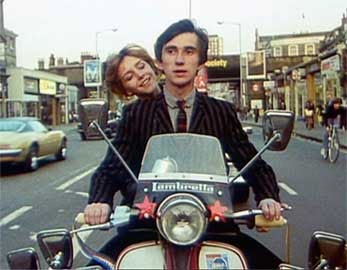
Quadrophenia

This post is in honor of The Who. Since they are starring in the Super Bowl halftime show, it only seemed fitting to talk about this great movie today.


Music by The Who. Acting debut of Sting. Mods vs. Rockers. Music by The Who. Scooters everywhere. The end of innocence. This is a coming of age tale set against the backdrop of early 60's mods/rockers riots in Brighton. Did I mention the music by The Who?

In case you hadn't noticed, I love The Who. The soundtrack and performance footage alone make this film worth seeing. But add to the tunes a wonderful story of a young man trying to find his place in the world. Jobs, girls, drugs, music, scooters. All the choices that, in our own way, we all faced during our turbulent adolescent years.

Director Franc Roddam does a terrific job with this "angry young man" story that is inspired by the Pete Townsend rock opera of the same name. Phil Daniels as Jimmy carries the angst in every scene. I root for him to succeed, find love, mature and enjoy life. For him, as for most young adults, it is a difficult journey. But well worth sharing. For me it was the Punks vs. Rockers in the 70's, but the film's transcendent storyline really strikes home.

Quadrophenia is also the acting debut of Sting. The lead singer of The Police does a terrific job as Ace, the idol of all the mods. He lives and works in Brighton and is a central figure in the second half. I remain impressed with Sting's screen presence. All the actors do fine work. They give this film a very authentic mood.

This is a hidden treasure. The story, the scenery, the scooters and the soundtrack make Quadrophenia a film worth treasuring. Please feel free to buy me a copy of the DVD. I would love to own it!

Filmed in 1979, directed by Franc Roddam, written by Roddam, Dave Humphries and Martin Stellman, starring Phil Daniels, Leslie Ash, Mark Wingett and Sting.

Saturday, February 6, 2010

Thunderbolt and Lightfoot


This film is a combination of some of the most successful genres in cinema. Part caper flick, part "buddy" movie and part road film. Director Michael Cimino, in his directorial debut, fuses all three genres together to create one movie that excels in all three categories. Too often ambitious scripts and directors get lost in trying to do everything. But here, in Thunderbolt and Lightfoot, we have success in making a smart, interesting and compelling film.

This movie follows the exploits of Thunderbolt, played by Clint Eastwood, and Lightfoot, portrayed by Jeff Bridges. Eastwood is a bank robber who is returning to collect the loot from an earlier theft. Bridges plays his very irreverent and quirky friend who wants to be in on the action. They have to "put the band back together" and find the men who assisted in the original robbery. George Kennedy and Geoffrey Lewis play the ex-partners. Both Kennedy and Lewis do terrific jobs, but Bridges almost steals the movie. Admittedly, because of the wild nature of his character, his part is the most flamboyant. But Bridges does a wonderful job of making Lightfoot accessible to the audience. He was rewarded with an Academy Award nomination for Best Supporting Actor.


Clint Eastwood met writer/director Cimino while Cimino was doing a re-write on one of the Dirty Harry movies. He pushed the studio to allow Cimino the opportunity to make this movie. Cimino gets a terrific performance out of Eastwood in return for Clint's faith. Eastwood, as Thunderbolt, is more personal and accessible than usual. With this coming during his Dirty Harry period, audiences were not prepared for this kind of a Clint Eastwood. That hurt the film at the box office. But the cult following for Thunderbolt and Lightfoot shows the value of the effort. Cimino's next film, 'The Deer Hunter', won Best Picture and earned him a Best Director Oscar. Then came 'Heaven's Gate'. The problems of budget, ego and horrible box office of 'Heaven's Gate' made Cimino persona non grata in Hollywood for almost a decade.

One character that is not mentioned in the credits, but deserves a mention here, is the big sky country of Montana. Cimino uses the mountains, vistas and prairies as an important part of the story. The cinematography is beautiful. I have since visited Montana. It is a most amazing place. The sky looks endless and makes all things seem possible. That confidence and beauty come across on screen. Magnificent country!

While this film is part caper flick and part road movie it is the "buddy movie" elements that are the most durable. The relationship between Thunderbolt and Lightfoot make this film the classic that should be seen by more. The resolution at the end of Thunderbolt and Lightfoot is still being discussed.I know you will enjoy this movie!

Filmed in 1974, directed and written by Michael Cimino, starring Clint Eastwood, Jeff Bridges, George Kennedy and Geoffrey Lewis. Also, look for Catherine Bach and Gary Busey in early roles in their careers.

Friday, February 5, 2010

Chinatown


The most important thing that I can say about this movie: I was thinking about the events, how and why they happened, as if I was the lead character. Chinatown pulls you in and makes you feel like a part of the story. Writer Robert Towne, who won an Academy Award for his script, does a superb job of involving the viewer. Throughout the movie I was wondering what each clue might mean, what would be the next step and how could everything be linked. To me, that is the sign of a fantastic script. Towne has done terrific scripts like 'The Parallax View' (see my blog), 'Bonnie and Clyde' and 'Tequila Sunrise', but this is his best work. The script would make Raymond Chandler or Dashiell Hammett proud.

Chinatown tells the story of Jake Gittes (Jack Nicholson). He is a private detective in 1930's Los Angeles. He is hired by a wife to investigate the activities of her husband. She is suspicious of infidelity. He finds what he believes to be proof of the cheating. But he has been used and lied to and everything blows up in his face. This is insulting to our lead detective and he is off on a chase for "the truth". The search for evidence leads him to the halls of power within LA. He becomes involved with what he believes to be a vast conspiracy. But, as we all know, when you mess with those in power they mess back. Things don't always work out for Jake. But, in true film noir tradition, nothing will stop our lead from pursuing the facts. No matter where they lead and no matter the consequences.


The most famous scene is when Jake gets his nose sliced. The man with the knife is played by director Roman Polanski. This is the first film Polanski made in the U.S. after the terrible tragedy of Sharon Tate. Producer Robert Evans wanted a European to direct this film. He wanted the look and feel to be that of someone who did not grow up in America. Polanski did a fantastic job and received an Oscar nomination. The film is gritty and very intriguing. I especially liked the few moments of introspection that Polanski allows detective Jake Gittes. Those small pauses give us, the viewers, the chance to contemplate events while the lead does as well. It is an excellent touch. Sometimes directors are in such a hurry for the next "exciting effect" that they don't give us time to enjoy what is going on. Thankfully Polanski does not fall into that trap.

This film is a slight twist on classic film noir. It is set in the 30's, but has some modern twists to traditional noir. It is more in the modern style and provided the springboard for the resurgence of noir. This movie provided much of the basis for films like 'L.A. Confidential', 'Memento' and 'The Grifters'. Faye Dunaway, portraying Evelyn Mulwray, is a fantastic Femme Fatale. She entices Nicholson into moving over to the "dark side". The viewers can never be sure when she is honest and manipulative or dishonest and manipulative. But like all noir femmes she is manipulative. Both Dunaway and Nicholson received well-deserved Oscar nominations for their work. I believe that this is the film that established Jack Nicholson as a leading man. He had been a character actor, but his fine work here propelled him to super stardom.


Chinatown has an unexpected ending and shockers of details along the way. It is intelligent, well-acted, directed and written and is most entertaining. Be sure to netflix, download, rent or buy this great movie!

Filmed in 1974, directed by Roman Polanski, written by Robert Towne, starring Jack Nicholson, Faye Dunaway, John Huston and John Hillerman. For further ruminations upon film noir see my blog about 'Double Indemnity'.

Thursday, February 4, 2010

Colossus: The Forbin Project


Before Skynet in 'The Terminator'. Before Whopper in 'Wargames'. There was Colossus:The Forbin Project. This is the first computer designed to protect humans that decides to rule instead. This film is done on a small special effects budget. No digital effects, no CGI, no cybernetic organisms. Just a bone-chilling story designed to instill both worry and thought.

The United States builds a supercomputer to take the personal/emotional (i.e. human) decision makers out of the nuclear loop. Only a purely logical, non-emotional computer can be trusted with Armageddon. Of course, once the computer becomes self-aware it decides that it is better than humans and decides to take over the world. Colossus' inventor, Dr. Forbin, must figure out some way to stop this machine.

Eric Braeden portrays Dr. Forbin. He is best known for his 20+ years on 'The Young and the Restless', but at the time he was a bit of a sci-fi star. He was also featured in 'Escape from the Planet of the Apes' and 'Six Million Dollar Man'. He does a very nice job here. He comes across as smug, superior, non-emotional and demanding. Just like the computer he invents. The script, written by James Bridges, is tight and intellectual. The story moves along quickly to a very surprising ending.


Colossus: The Forbin Project is intense and believable. A thriller that relies on intelligence, not monsters and explosions, to create suspense. It was also well ahead of its time. Themes featured in Colossus are still in vogue today. This film deserved better at the box office, but we can enjoy it today.

Filmed in 1970, directed by Joseph Sargent, written by James Bridges, starring Eric Braeden, Susan Clark, Georg Stanford Brown and Gordon Pinsent.

Wednesday, February 3, 2010

M*A*S*H


If you are a big fan of the television show be forewarned. This film, from Director Robert Altman, is much darker than the tv show. There is drinking, sex, drug use, racial stereotypes and all sorts of other "politically incorrect" things. It is full of black comedy, sarcasm and biting satire. I believe that Altman, screenwriter Ring Lardner, Jr. and novel author Richard Hooker are making a strong statement about war and how individuals survive armed conflict. The characters in M*A*S*H use that dark comedy to somehow manage to get through the pressures of war. Unless you have been through it, I don't think anyone can understand how awful things can be. But everyone involved is attempting to survive the horrific experience. "Gallows" humor and dark comedy are many individuals coping mechanism. This film reflects that survival technique to maximum effect.

M*A*S*H is set during the Korean War. The film follows the story of the 4077th Mobile Army Surgical Hospital. I use the term "follows the story" loosely. This film is more a collection of vignettes than a cohesive plot. Some moments are more poignant or funny than others, but the film in total is Robert Altman's best work. He allows the actors to develop characters with which viewers can relate on a personal level. This almost improvisational technique results in fun and challenging chaos on screen. You may find one episode better than another, but the film is funny!


Altman has a history of using ensemble casts. He does so here with some of the generation's best actors. Donald Sutherland (Hawkeye) and Elliott Gould (Trapper John) play two doctors who were drafted into serving in the military. They use copious amounts of alcohol to numb themselves to the carnage. Robert Duvall portrays Major Frank Burns. Burns is the "regular army" antagonist to our two doctor protagonists. He is the constant butt of jokes and ridicule. Other fine actors are also in M*A*S*H. Tom Skerritt, Rene Auberjonois, Roger Bowen and Sally Kellerman all have prominent roles. Director Altman uses this terrific cast to excellent results. Whether you prefer the football sequence, "Hotlips" scenes, the surgeon's visit to Tokyo or the "suicide is painless" vignette there is something to entertain everyone.

Although the film is set during the Korean War it was filmed and released during the height of the Vietnam War (1970). There was much attention, both pro and con, heaped upon this film as a metaphor for Vietnam. There are portions of this film that provide support to both sides of the stay in Vietnam debate. Some people boycotted the movie because it was "communist sympathizing". I never found that to be true. M*A*S*H shows that war can be horrific and that, sometimes, the people in command make terrible decisions. It also makes a strong statement that most people involved in a war would rather be at home. That's not "communist". I think that is just real.

The cast is excellent, the directing is terrific and the script is hilarious!


One note: Sally Kellerman has a very brief nude scene. She was 33 at the time. A few years ago she appeared nude in 'The Boynton Beach Club'. She was 69 for that nude scene. Good for her! That takes courage. It is probably much easier for a 33 year old woman to do a nude scene than someone who is 69. But she is not backing down to anyone or any year.

Filmed in 1970, directed by Robert Altman, written by Ring Lardner, Jr., starring Donald Sutherland, Elliott Gould, Robert Duvall, Sally Kellerman and Roger Bowen.

Tuesday, February 2, 2010

His Girl Friday


Hilarious. The dialogue is as witty as has ever been filmed. The pace is breakneck speed. I find myself trying to stop laughing at one line because I have another laugh or two lined up. Cary Grant and Rosalind Russell are fantastic. They have terrific timing, great chemistry and some of the best dialogue imaginable. You have to pay attention to the dialogue. Often there are two conversations going on simultaneously. You can follow one or both, but do follow along. Don't miss anything.

Based on the play The Front Page by Ben Hecht and Charles MacArthur. Charles Lederer adapted the screenplay with wonderful results. Director Howard Hawks insisted the part of Hildy (Russell) be rewritten for a woman. This allows for a romance subplot underneath the newspaper main storyline. Cary Grant owns a newspaper and is divorced from Rosalind Russell. She returns to the paper to inform her ex that she is remarrying. He constructs a plot to regain her affections and to get her back as his ace reporter. Ralph Bellamy does a nice job as the kind, but slow, husband to be. Of course, he has no chance when put up against Cary Grant. But then who does?


His Girl Friday is a classic comedy done at light speed. Don't go for popcorn because you will miss out.

Filmed in 1940, directed by Howard Hawks, written by Charles Lederer, starring Cary Grant, Rosalind Russell and Ralph Bellamy.

Monday, February 1, 2010

Dawn of the Dead

Note: This blog is referring to the classic 1978 original and not the remake.


This is the sequel to one of the most successful films ever made, George Romero's 'Night of the Living Dead'. Dawn of the Dead was filmed 10 years after the release of 'Night', but is set in the weeks following the first film. For those who don't know, 'Night' is the story of zombies and their rise in rural Pennsylvania. Zombies are human beings who have died and returned to a new "life". They have no emotions, little coordination and lots of hunger for human flesh.

Our film opens upon a television station that is attempting to cover the rise of the zombies. The personnel are laboring to show this event and provide survival information for the station's audience. But society in general and the station in particular are breaking down. The pressure of a world in which the dead rise to attack and devour the living is too much for most to bear. Dawn of the Dead focuses upon four individuals looking to survive; 2 SWAT team policeman, a traffic copter pilot and his tv executive girlfriend. These four fly off in his helicopter for Canada. They hope to escape the horror that has spread across the U.S.


They eventually decide to take respite in a large shopping mall. The four decide to land and look for supplies. But upon reflection they realize that they have no where to go. The mall will become their home. A battle with the zombies that inhabit the mall and then with a gang of thugs results in the deaths of some of the party and the attempted escape of others.

I remember walking out of the theater, in 1978, after the debut of this film. I was eager to see this sequel, having so respected and enjoyed the first film. Upon exiting the movie I turned to my friend, Jordy Long, and said "this is one of the best statements on America's consumer society I have ever seen". After watching the film again this week I come to the same conclusion. Writer/Director George Romero uses zombies and science fiction/horror to share a viewpoint on the commercial nature of American society. In the film the zombies are compelled, by some unknown instinct, to return to the shopping mall. As is said in the film "instinct, memory, this place was important in their lives". The zombies have died and returned to life, but they want to return to what was important-The Mall.

For me, the final credits make the point. After some of the survivors escape the mall the final credits roll. They overlay a shot of the interior of the mall. The zombies are wandering the stores, looking for nothing. They don't sleep, care about their appearance or need anything, but they still wander the mall. This metaphor for our consumer society could not be more evident. Just change the make-up and the zombies become some of the people wandering any mall. Looking for something, but they don't know what.


Tom Savini is credited with the make-up and cosmetic special effects for Dawn of the Dead. Much of his work is trailblazing and is still being copied today. His work makes this film the "apocalyptic horror masterpiece" that Leonard Maltin so appreciates. The real gory parts come mainly in the first and last 20 minutes, but pop-up occasionally in the rest of the film. Dawn of the Dead is not for the squeamish! Even though I know it's a movie, and I have seen it before, I still cringe when the zombies start eating a person's intestines while they are still attached.

Romero also goes for the dark comedic effect. The sight of the blue-skinned Hara Krishna zombie, with his tamborine, is a riot. He does not take things too seriously. It is, after all, a movie. Also, George Romero should be credited for creating a cottage industry. There have been dozens of zombie movies, tv shows and books. 2009's 'Zombieland' film and bestselling book 'World War Z', among many others, owe their success to Mr. Romero.

Filmed in 1978, directed and written by George Romero, starring David Emge, Ken Foree, Scott Reiniger and Gaylen Ross. Look for a cameo by George Romero. He plays the television director in the opening sequence.